This is Miriam!!! I apologize for not writing blogs recently. For me, it's hard to write blogs. just that kind of writing (as opposed to just writing down my thoughts in a journal). So, I'll warn you ahead of time that this may not be as good of a blog as my parents, but I'll do my best :)
So, Beerotayim was just SO much fun!!
It's what my parents call "the Disney version of a Bedouin camp." Let’s just say, after being in jordan (we'll have to blog about those camps another time) we were definitely able to appreciate the clean food and bathrooms. Speaking of the bathroom s, they were beautiful! I mean the sink bowls were painted with lovely designs and just an amazing view out the windows over the sinks. So, as you’re washing your hands you just look out the window and you think "wow!!!!"
At Beerotayim, you’re so free. That’s what I loved, being able to do WHATEVER I wanted! We went with another family (the one we were supposed to go to Jordan with, Nomi, Belinda, Jeremy, and Eitan). I had such a great time with Nomi and in those few days we had so much fun together! The adults did their adult things the whole time, so we hung out and did whatever we wanted :). We played crazy eights and salty fish (like red light green light, but the person who turns around can try to make you laugh and that makes you have to go back to the beginning too, so, I never won).We drank Bedouin tea (sugar with some water and tea leaves mixed in) and lots of water! Also, we wrote a lot. But, I haven’t told you what else we did which has been my dream since we decided to go to Israel.
WE…RODE…ON…CAMELS! That was just so exciting. We weren’t allowed to pet them because that was an insult to them, but it was definitely good enough just to ride them. First, we had to get on and the camels had to stand up, right? Ya, well, that was an adventure. Pretty much, the camel would stick it’s but up in the air and then it would bring its head up. It was like being on a roller coaster…but without being strapped in. ahhhh!
It was so nice being on the camel because since you’re farther from the ground it’s much cooler. We rode for about 30-45 minutes. Then, we stopped in the shade and made lunch. We made tea, tahini, salad, cheese, and bread. The way they made the bread was very cool. The mixed up flour, water, and salt into thick dough and made it into a patty. Then they buried it in the embers of the fire they’d made and took it out about 20 minutes later, they took it out. It was delicious!!!! The lunch was wonderful. After that we rode back to camp.
Well, that’s it for now!!!!
NOTE: I am going to need a little help from my parents to put pictures in, because that’s confusing. So, just to let you know, I’ll post another blog with pictures of the things I've explained.
Friday, June 10, 2011

Tuesday, June 7, 2011
The Truth about the Adloyada
Jay blogged a while ago about the Adloyada, the Purim parade with incredibly creative costumes and floats put on by the local environmental high school. I'm adding a few photos.
Here is what the author of that blog looked like:
Here is what the author of that blog looked like:
 |
| Our correspondent onsite at the Midreshet Ben-Gurion Adloyada |
 |
| Mishpocha Stein (sorry, girls!) |
 |
| Who can resist a hypodermic syringe of chocolate? |
 |
| One of the busiest days of the year in our usually sleepy town |
Crossing Borders and Visas
A couple weeks ago (May 20-23) we went to Jordan. It was surprisingly easy to get there: a two-hour drive to Eilat, including a stop at Yotvata dairy for their famous chocolate milk. Rebekah, Jay and Miriam think it makes a good breakfast.

We parked the car and walked across the border.
 |
| You can see how close it is from our car to the border, background |
There’s a sign that clearly prohibits photography, but I saw other people with cameras, so I asked the guard on the Israeli side. “Photos aren’t allowed, but people do,” she said, with what I have come to recognize as typical Israeli respect for rules.
 |
| Walking from Israel to Jordan |
Crossing the border was uneventful except for one thing: they cancelled our visas which we had just been granted a few weeks earlier.
All US citizens automatically are granted 3-month visas. Because we are going to be in Israel for 6 months, we had to get a 3-month extension. In theory, we could have left the country and come back, getting a new 3-month visa, but given the current instability in the region, we didn’t want to count on that.
Instead, we entered the maze of Israeli bureaucracy. We worried, having heard stories from friends worthy of old-style USSR treatment, waiting for hours, only to be turned away for using the wrong color ink and told to come back tomorrow. We were very fortunate to have our friend Raz, head of tourism for Ramat Negev, as our guide in this process.
He scheduled a day for us to go to Beer Sheva. His office had called ahead and gotten us the forms to fill out. He also had a letter explaining how we are part of Partnership 2000, the first of many exchange families between Ramat Negev and Colorado, designed to bring American Jews to Israel to deepen US-Israeli understanding, etc, etc.
On the appointed day, we met Raz in our town and drove into Beer Sheva, the closest big city, about 45 minutes away. We were to be there at 8 am. We left in plenty of time and were making good time, until suddenly we were going 10 mph behind six tractors in the road. Raz said they shouldn’t be there, even called the police to report the “shesh traktorim b’derech.”
We finally made it to Beer Sheva and were through the metal detectors and in to the visa office by 8:20. Too late. I didn't understand completely, but think they give out numbers until 8:05. After that, you're out of luck. A dispute between Raz and the woman behind the desk, complete with explanation (shesh traktorim b’derech!) . He returned, with a big grin and a number. We waited for a bit over an hour until our number was called, then went up to the desk. The woman looked at us and another dispute ensued. Evidently Raz had answered her question of how many people we were correctly, 2, but omitted that we were there for 4 visas. Had she known, she wouldn’t have given us a number. Outmanoevered, she went over the forms, had us fill out some more, made a great show of how much work it was to staple our pictures to the applications, and finally put everything in a pile with Raz’s letter on top. She sent us home, told us to wait for a call.
No one called, but Raz checked and finally we were told to come back on the day our visas expired. We did, by ourselves this time. We weren’t sure exactly which building it was and first mistakenly tried to enter the mall next door. The security guard was very friendly and told us, in perfect English, to go one door down. It was still a few minutes before 8, so we waited with a group of people, about in the middle of the pack. The doors opened promptly at 8. Jay and I, 3 months into our trip, obviously haven’t learned even the most basic skills necessary for navigating in a country where the concept of a line is a joke. We were the last ones through.
This time, we did get a number. When we got to the desk, we found that the dour immigration official, whose job it is to deal with immigrants, spoke very little English. We thought perhaps she should change jobs with the mall security guy. She did, however, go laboriously over all the information they’d had on the forms for the past 3 weeks and slowly print out the visas. We left, quite pleased with ourselves.
So, imagine our surprise when, not even three weeks later, at the border, our passports were handed back to us looking like this:
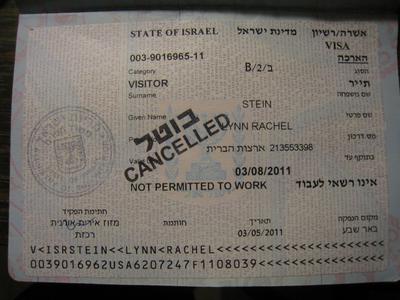 |
We asked why, and were told it had to be that way. We’d get new visas coming back. They didn’t know if they would be for long enough (we would need a little over two months) or not. They might be for three months, or they might be for one. Have a nice trip.
Four days later, we were headed back to Israel. We handed our passports to immigration and hoped for the best. The first one went very smoothly. “Great!” Jay said, standing behind the counter, “3 months, no problem!” I kicked him, hoping he hadn’t given us a kenahora (Yiddish word for evil eye, or jinx). Sure enough, “Let me have that passport back,” the woman behind the counter asked. Reluctantly, Jay slid it back. She hadn’t noticed the cancelled visas, but now had to check into them. After consulting with several co-workers, she decided they’d been cancelled in error. Who did that? Eilat border control? Couldn’t be. In the end, they decided we weren’t responsible for the error and issued the standard 3-month visas. Welcome back to Israel!
Monday, June 6, 2011
The Tower of David
The Middle East is filled with mysteries and misperceptions. We came across a striking one in one of our visits to Jerusalem. On that trip we toured the Tower of David, a citadel near right near the Jaffa Gate, one of the most popular entrances through the walls of the old city. The most iconic part of the citadel is the tower pictured below. You'll find images of this tower in paintings, illustrations in prayerbooks, tour guides, and even matchboxes.

This tower began to be referred to as the Tower of David by Western visitors in the nineteenth century. They mistakenly thought that it had been built by King David, the Jewish king who had his capital in Jerusalem around a thousand years BC. Although King David was one of the great builders of Jerusalem, the Tower of David has nothing to do with him. Indeed, it’s about as far removed from King David as could be.
To start with, the Tower of David was not built during King David’s time. It was built in 1653 by the Turks, who ruled Jerusalem at the time. It’s actually a minaret for a mosque built by the Mamluks, who ruled Jerusalem mainly in the fourteenth and fifteenth centuries. Another tower within the Citadel, the Tower of Phasael (pictured below), has also from time to time been referred to as the Tower of David. It was built by King Herod, about 35 years BC.

The citadel itself (pictured below, first from the outside and then on the inside) was probably established by King Hezekiah around 700 BC, and added onto by numerous rulers ever since. The Tower of David isn’t even in the part of Jerusalem built by King David. His city was to the east of what we now know as the old walled city of Jerusalem.


Here we are relaxing at our favorite coffeehouse and bakery in the old city after our tour of the Tower of David citadel.

The Tower of David is a great example of why in the Middle East one needs to be very skeptical. Whenever someone here tells us something, the first thing we’ve learned to think is, “I wonder if that’s true.”
Friday, June 3, 2011
I Think I’m Becoming a Unilateral Withdrawalist
Obama must have thought it was a good idea at the time. With so much unrest going on in the Arab world, he wanted to position the United States as the supporter of those groups pushing for more democracy and human rights. There was just one problem to doing so. The United States supports Israel and many Middle Eastern Muslims hate Israel. If it came out that the US directly supported any Middle Eastern group, that group would immediately be charged with complicity with Israel.
Obama figured out a way to get around that problem. He would gently nudge Israel and the Palestinian Authority to reenter into peace negotiations based on some timeworn formulas. On the face of things, I can see why Obama thought this was a good idea. Israel can’t go on indefinitely following the same policies, the UN General Assembly is going to vote to support the formation of a Palestinian state in a few months, and besides, Obama has long wanted to do something to help the Palestinians. Somehow, he didn’t anticipate that Bibi would do what he always does: use Israel’s widespread public support in the US to defy Obama and hammer him into submission.
Surprise! Bibi’s strategy worked again. Now, all the parties are furious at Obama, and the chances for any meaningful negotiations are as remote as they’ve ever been. That’s not to say that there won’t be any meetings between the parties or arrangements set for negotiations. The chances that those negotiations will succeed are virtually zero. Benjamin Netanyahu and Mahmoud Abbas have no intention of ever coming to agreement. For both of them, their coalitions would collapse should they commit to a deal, and neither of them has expressed any interest in facing that situation again. Given that Abbas is going to retire from public life later this year, I expect both men will simply run out the clock.
While the political situation may be in hard cast deadlock, many elements of the conflict continue to change, almost entirely for the worst. The non-Jewish residents of the West Bank and Gaza continue to live under unjust and poor conditions, and become ever more embittered, garnering more worldwide sympathy. Israel’s enemies throughout the world gain more support and succor. Ever more radical organizations form and build membership. Israel becomes more and more isolated. The attacks on Israel become ever more sophisticated.
I can only see one way to proceed that doesn’t require another decade or two of watching a degrading status quo. Israel simply withdraws from the vast majority of the West Bank and turns over control of Gaza and the West Bank to the Palestinian Authority (PA). At that point the PA will have been freshly recognized by the UN as a sovereign state. Israel would also leave the PA in control of its own borders. All this would be done without any quid pro quo from the PA.
Turns out I didn’t invent this approach. It’s long been an option discussed in peace negotiations. It even has a name: unilateral withdrawal. Gaza is a good example of where it’s been implemented, although the plan I’ve laid out here would differ from that employed in Gaza in two important ways: The residents of the territory controlled by the PA would now be citizens of a sovereign state and their borders would not be controlled by Israel.
The benefits of unilateral withdrawal are many. The residents of the territories would no longer be treated as second-class citizens. They would have full citizenship in their own country. The daily media reports of interactions between the IDF and the residents of the territories that just infuriate people all over the world would end. Israel could no longer be criticized in the UN or the international press for its treatment of the Palestinians. There would be no call for blockade busting flotillas or smuggling tunnels. The rationale for many boycotts and other attempts to isolate the Jewish state would go away. Israel would begin to reverse the moral decay that comes from being an occupying power. All this could happen relatively soon.
I know my plan isn’t perfect. I only mean to suggest that it’s less horrible than the alternatives. We know very well from what happened in Gaza what the problems with unilateral withdrawal are. The Palestinians will be angry that Israel unilaterally chose its new border. Israel, at great expense both monetarily and politically, will have to resettle the settlers who presently live beyond where the new border will be. Extremists among the Palestinians will declare victory and mobilize for a follow on attack. Israel will likely have to educate its new neighbors regarding the responsibilities of a sovereign nation. Gilad Schalit will still be held by Hamas. Control of Jerusalem, the demands of the refugees, and the acceptance of Israel by its neighbors will all remain open issues.
Even given these problems, I think unilateral withdrawal is better than the status quo. The Gaza withdrawal was painful for a long time, but on an ongoing basis, it’s much less painful than holding Gaza was. Meanwhile, Israel’s security situation continues to degrade. Simply holding land is not the answer. Only a bold move can get Israel out of this self-defeating spiral. Unilateral withdrawal could well be that bold move.
At least, that’s my unsolicited advice to our hosts here in Israel. We spend a lot of time reading, talking, and thinking about the huge problems and changes going on here in the Middle East. I offer my advice knowing that there’s little chance it will be taken by those in power here. Do you think I got it right, or did my inexperience in the region cause me to miss something important? If you feel strongly about the issues discussed above, please feel free to use the comments section below to share your ideas.
Sunday, May 29, 2011
Cousin Trip - The Overview
My cousin, Robin, from San Francisco, came to visit us for a week. We had a splendid time together. We covered a lot of ground, but all of it at a pretty slow pace. We are known as the “le-at, le-at” (means “slow” in Hebrew) family because we spend twice as long at every location as the guide books suggest. Miriam and Rebekah were practically glued to Robin, often holding her hand or in her lap, talking a mile a minute, often both at once in Hebrish in their enthusiasm. The conversations veered wildly, from where we were going to what we’ve already seen, from geology and archaeology to what’s going on in the Middle East, and getting all the details from Robin about her new business of science walking tours, including what’s on each tour and editing her marketing materials. Listening to them all talk, I was amazed by how much the girls have learned and grown these few months.
Robin created a terrific blog, which I recommend to all of you. http://robinsdiscovery.
To start, Miriam and Rebekah and I picked Robin up in Beer Sheva and did a little exploring there. We’ve been there before, but only for shopping or visas. We know many of the malls there: the Big, the One, the Seven, where we stock up on natural foods, spices and halvah, as well as (incredibly expensive by US standards) clothes for the fast-growing girls. Now we know where to get falafel too.
 |
| The beginning of the falafal-a-day taste test |
 |
| On the hike over, we find flint and chalk in the Zin |
 |
| The tent is just as remote, but we get there faster for having been there before |
 |
| Majdalen made the pita from wheat she'd grown |
 |
| This time we got to make our own |
 |
| Miriam's turn |
 |
| Our meal, including labane cheese Majdalen made from her own goats' milk |
 |
| Majdalen |
 |
| Fond farewells -- we'll be back |
The third day we joined an archaeological dig at Beit Guvrin. We dug in a cave, separating pot shards and bits of bone from the dirt. Then we sifted the dirt, looking for anything we might have missed. Others in our group worked at clearing dirt from some stairs. When they finished, it was the first time the stairs had been exposed in over a thousand years. After the dig, we explore some of the caves, tunnels, and tombs in the area.
 | ||||
Our digging site in the basement of a house
|


 |
| Burial tombs |
 |
| I take a nap in the tombs Then we headed up north, to Zichron Jaakov. I was very interested to see this town, as when we were considering coming to Israel, it was a place that was frequently suggested. I can see why. It sits up on a green hillside, a few minutes from the Mediterranean, surrounded by farms and vineyards. It is beautiful, filled with gracious old and stunning modern homes, many lovely and lush gardens and lots of Anglos. There is a main pedestrian street lined with shops and cafes. |
We stayed with our new friends, Amy and David and son Eli and daughter Iris. Feels like we’ve known them forever, hard to believe we met for the first time the week before, when they come down to Sde Boker to meet their cousins and our friends, the LeBlancs from Boulder. They are incredible cooks, warm hosts, and we talked and laughed until late.
A side note about David. He is a bow maker. When he and Amy came to stay with us last week, we didn’t know them at all except that they were the LeBlanc’s cousins. At some point in the evening, we learned that he is a bow maker. A week before, Rebekah’s violin teacher had told us there was something wrong with her bow. She wasn’t sure what, but we needed to take it to be looked at. We couldn’t find anyone in Beer Sheva, but had the name of someone in Tel Aviv. Suddenly, the only bow maker is Israel is sitting in our house! Talk about the universe providing what you need! (Turns out there was a spot of grease on the bow, causing it to glide over the strings instead of catching them. He fixed it with soap and water.)
 |
| Ruins at Caesaria |
The next morning, after a breakfast of matzoh brei with real maple syrup and David’s excellent coffee, we headed off the Caesaria, a lavish Roman port on the Mediterranean, founded by King Herod in 20 BCE. The water engineering was especially advanced. Two aquaducts brought water to the town. There is also a hippodrome and a large amphitheatre.
We had so much fun that we decided to stay another night. We went back to David and Amy’s. They had spent the day making strawberry jam. Yum! We had dinner out—Chinese food (our first time on this trip, definitely not the Jewish national cuisine in Israel) and Aldo’s (excellent gelato which we search out in Jerusalem and Eilat, though the original is here).
 |
| Modern charioteers |
 |
| The amphitheatre is still used for concerts |
 |
| Groupies Nomi and Miriam |
 |
| Tourists at the beach |
 |
| Amy, a bit punchy from making 40# of strawberry jam |
 |
| Rebekah doing quality control |
 |
| Miram, Rebekah and Eli at Aldo's |
The next day we went to the Artists’ Colony where David has a studio. It is a magical place, a dozen studios in a ring around a garden. Dogs wander among the bright flowers and the artists all spend lots of time explaining their work to us.
 |
| David explains to Bekka how the horsehair is attached to the bow |
 |
| David planing a bow |
 |
| Next door, a violin and cello maker |
 |
| There's also a glassblower |
 |
| The women in the paper mache studio are having a blast |
 |
| They create very detailed characters |
 |
| A sculptor carves gigantic, fanciful stone heads from Golan basalt |

Then back home and the next morning Robin and I left for 3 days in Jerusalem. It was such a treat to get to spend uninterrupted cousin time together. Robin experience Jerusalem for the first time. Robin’s Hebrew, after many, many years of Jewish summer camp 30 years ago, is about as good as mine after 4 months here. We wandered around the Old City, took many photos, ate well and often, and marveled over all the contrasts.
It was a wonderful week, so full of history, water, sun, archaeology, hiking, food, friends, and laughter. It was a special delight to be able to share these experiences with my cousin.
Saturday, May 28, 2011
We Visit a Partially Excavated Townsite
One of the things I like the most about Israel is the county's network of national parks and nature reserves. The Israel Nature and Parks Authority (INPA) is one of the best organized and most extensive organizations in the entire country. Most of the country's major archaeological and natural interest sites are managed by the Authority. We bought a national parks pass shortly after our arrival here. It's been by far our smartest purchase. Whenever we travel we make a beeline for the INPA's facilities.
Even though it's nice to visit the INPA's premier historical sites, which typically feature protected parking lots, gift shops, bathrooms, and well excavated attractions complete with interpretive signs, it's nice occassionally to get to a site long before it's gotten the full INPA treatment. When we do, it provides an opportunity to wander around without the usual crowds and to see the ruins in their natural state. Plus it makes us feel more like an explorer than a tourist, at least a little bit.
One such site we visited was Susita, which was an ancient Roman town perched on a hilltop overlooking the Sea of Galilee. The town was probably originally founded in the first century BC and was continually occupied until it was destroyed by an earthquake in the year 749. Susita was abandoned after the quake and never reoccupied.
To get to the trailhead we first had to drive down an unmaintained cracked and potholed road. Here we are at the trailhead.
 Next, we hiked to the old town site by walking on a trail that runs between two minefields. In the Golan Heights, it's important to stick to trails that have been cleared of mines.
 When we get to the old townsite we find that some parts of it have been excavated. Here we are walking on the old collonaded street, paved in the Roman style with stone blocks.
 We reach the site of the old forum. One way to tell that a site has been destroyed by an earthquake is that the unexcavated columns are all facing the same direction.
 These columns are waiting to be excavated.
 The site is filled with lots of great unrestored architectural features that you can walk right up to.


 Here Rebekah is brushing the dust off a bit of floor mosaic in order to get a better picture.
 Until the 1967 war, the Israeli army maintained a base here. It was abandoned after the war, but with lots of furnishings and equipment left in place. You can see that it was designed with some sensitivity to fit in with the ruins.

 Here we are, walking further down the collonaded street, which probably also served as an open air market.
 Here's a partially reconstructed column with an ornately carved capital.
 Here is some writing Lynn found carved into the stone block paving the street.
 This old house on the side of the cliff must have featured some view.
 We love visiting ruins before they're completely excavated.

Subscribe to:
Posts (Atom)